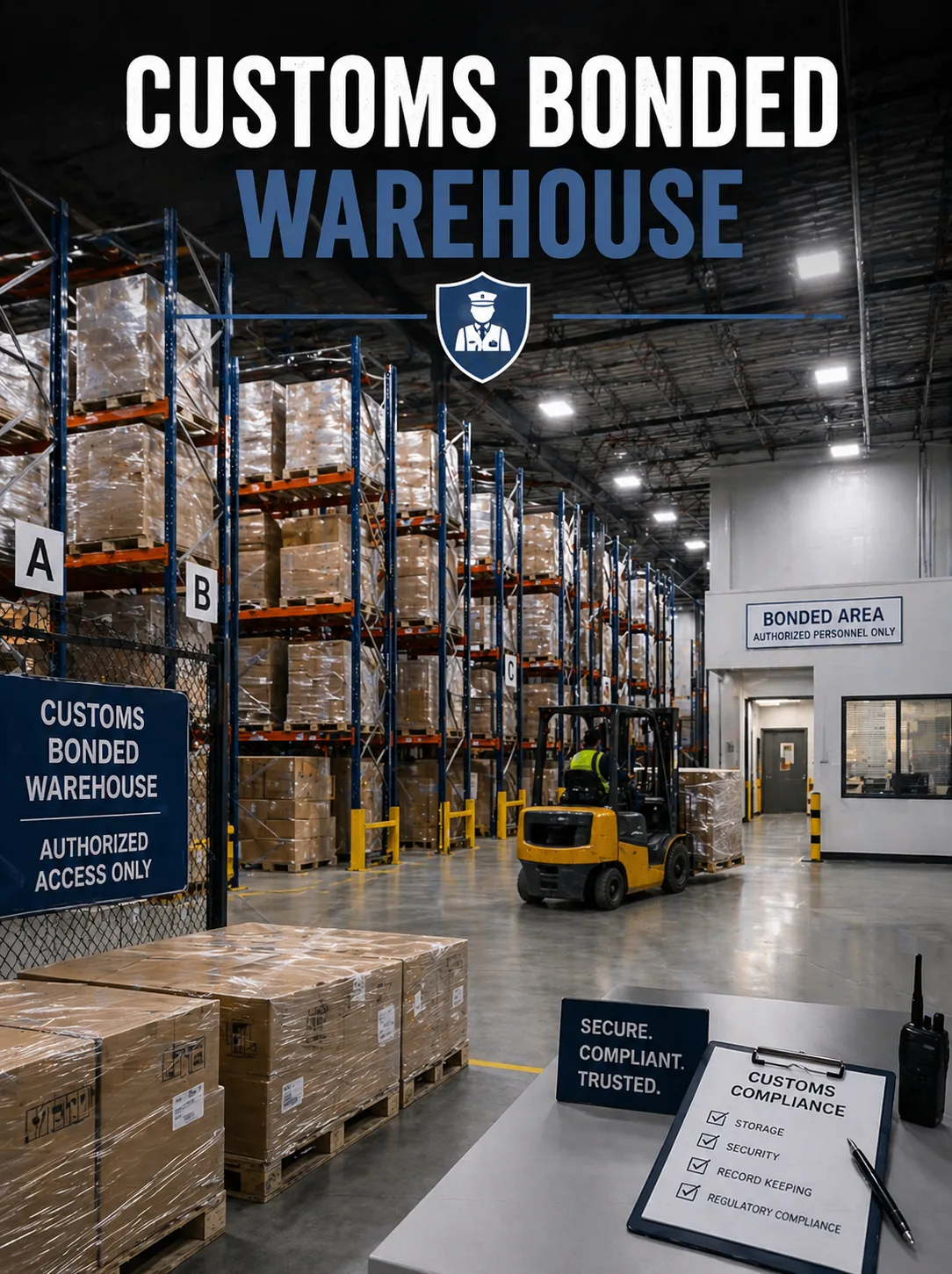
Gilbert International operates a customs bonded warehouse in Laredo, Texas. We hold four bonded classes — 3, 4, 8 and 11 — in one 250,000+ square foot rail-served facility at the largest inland port in the United States.
Freight crosses, comes into our building, and the duty clock stops. You pay when you withdraw for consumption, up to five years later. If the goods are exported instead, you may never pay U.S. duty at all.
The four classes we hold
- Class 3 — public bonded storage. Our license, your goods, your duty deferred. You don’t need your own bond.
- Class 4 — bonded yard and shed for heavy, bulky, and bulk liquid product.
- Class 8 — manipulation. Clean, sort, repack, relabel, and break bulk while still in bond. Withdraw only what you sell; export the rest duty-free.
- Class 11 — general order. Very few operators in this corridor are licensed to take G.O. freight. We are.
Most bonded operators hold one class. Holding four means your freight doesn’t have to leave the building to have something done to it.
The facility
- 250,000+ sq ft, with bonded and non-bonded space under one roof
- 60-trailer dock
- Private 10-car Union Pacific rail spur
- Food-grade certified storage
- Three hours from Monterrey — 220 km
How to start
Your broker files a warehouse entry instead of a consumption entry, the freight is consigned to us in bond, and it arrives. We handle receipt, recordkeeping, and withdrawal permits as you sell.
Tell us what the commodity is, roughly how much, and whether any of it is likely to be exported. That’s a fifteen-minute call.
Common questions
How long can goods stay in a bonded warehouse?
Up to five years from the date of importation, under 19 CFR 144.5. Most bonded inventory turns in weeks or months.
Can I repack or relabel product while it’s still in bond?
Yes — that’s Class 8. Cleaning, sorting, repacking, and changing the condition of merchandise are permitted under CBP supervision. Manufacturing is not.
Bonded warehouse or foreign trade zone?
Both defer duty. An FTZ allows manufacturing and has no time limit, but costs more to set up and run. A bonded warehouse starts faster, has a five-year limit, and permits manipulation but not manufacturing. For most importers moving finished goods, bonded is the lighter fit.
One call. No ticket queue.
Monterrey exporter evaluating bonded warehousing, or a U.S. distributor planning a nearshoring program — call us directly. Monday–Friday, 9am–5pm Central.
956-723-4308
6219 Gilbert Rd., Laredo, Texas 78041